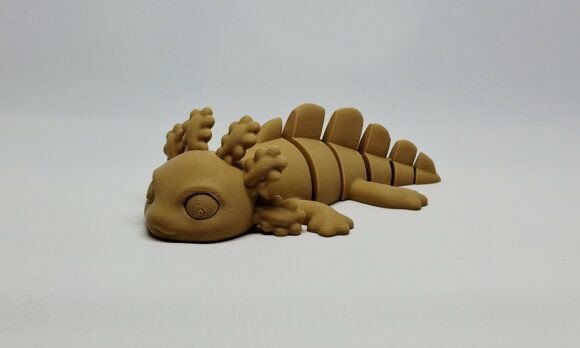
Flexi Axolotl STL 3D Print Model
In the landscape of modern digital fabrication, the transition from abstract code to tangible object is often seamless for complex geometries but can be surprisingly delicate when it comes to articulated structures. The Flexi Axolotl STL 3D Print Model represents a specific intersection of aesthetic appeal and mechanical simplicity, offering a practical case study in print-in-place design. For professionals, creators, and hobbyists alike, this model serves not merely as a decorative trinket but as a functional component within a broader workflow involving rapid prototyping, stress management, or educational demonstration.
Understanding how to integrate such models into daily routines requires looking beyond the visual charm of the axolotl itself. It involves evaluating the file’s structural integrity, the printer’s capabilities, and the intended utility of the final output. Whether used as a tactile fidget tool during long coding sessions, a gift for a colleague, or a test print for verifying slicer settings, the articulated nature of this design demands careful attention to preparation and execution.
The Mechanics of Print-in-Place Design
The core value proposition of the Flexi Axolotl lies in its classification as a print-in-place (PIP) model. Unlike traditional multi-part assemblies that require post-processing steps like gluing, pinning, or screwing, PIP designs utilize interlocking joints printed simultaneously with the main body. This significantly reduces the time-to-value, allowing users to go directly from slicing software to a fully functional toy without manual intervention.
From a process perspective, this eliminates a common point of failure in 3D printing projects: assembly errors. When working on tight deadlines or managing multiple small-scale projects, the ability to produce a ready-to-use artifact in a single print job enhances efficiency. However, this convenience introduces new variables regarding printer calibration and support generation. The smooth movement of the segments relies entirely on the precision of the nozzle diameter and the consistency of the extrusion flow. If the tolerances are too tight, the joints may fuse together; if too loose, the structural rigidity suffers, leading to sagging or breakage under stress.
Workflow Integration and Practical Use Cases
Integrating the Flexi Axolotl into your routine depends largely on your role and immediate needs. For remote workers and freelancers, desk clutter is a constant enemy of productivity. A compact, flexible figure offers a discreet way to manage tactile stimulation without disrupting focus. Its segmented body allows for bending and posing, providing a satisfying physical interaction that can help reset attention spans during deep work periods. This transforms the object from passive decor into an active tool for cognitive regulation.
For educators and content creators, the model serves as an excellent teaching aid. Demonstrating the principles of kinematics, joint friction, and material flexibility becomes concrete when students can manipulate a printed axolotl. It bridges the gap between theoretical knowledge and physical reality. Similarly, marketers and designers might use it as a tangible example of successful parametric design, showcasing how digital assets can be optimized for both aesthetics and function.
In a business context, these figures make effective low-cost corporate gifts or conference swag. They are lightweight, durable, and visually distinctive. Unlike generic promotional items, a well-printed articulated animal demonstrates technical competence and attention to detail, subtly reinforcing the brand’s association with innovation and craftsmanship.
Technical Preparation and Slicer Configuration
Success with the Flexi Axolotl STL begins before the printer even starts. The provided specifications indicate testing on devices like the Bambu Lab A1 Mini, which suggests compatibility with entry-level to mid-range FDM printers. However, achieving optimal results requires adjusting standard slicer profiles.
- Nozzle Diameter: Most standard nozzles (0.4 mm) work well, but finer details may benefit from a 0.2 mm nozzle if available. Ensure your slicer settings match your hardware precisely.
- Layer Height: A recommended layer height of 0.2 mm provides a good balance between surface finish and print speed. Thinner layers may improve joint smoothness but increase print time unnecessarily.
- Infill Density: Since the model is primarily structural rather than load-bearing, low infill (10–15%) is sufficient. This conserves filament and reduces internal stress buildup.
- Supports: While designed to be print-in-place, overhangs on the axolotl’s head and tail may require minimal support structures. Enable supports only where necessary to avoid damaging the delicate joints during removal.
Filament selection plays a crucial role in the final feel and durability. PLA is the standard choice due to its ease of use and dimensional stability. However, Silk PLA adds a visual depth that enhances the stylized curves, while Matte PLA helps hide layer lines for a more professional appearance. Avoid flexible filaments like TPU for the main body, as they can complicate the joint mechanics and make cleaning difficult.
Post-Processing and Quality Control
Once the print completes, the critical phase of quality control begins. Inspect each joint individually. Gently flex the segments to ensure they move freely without resistance. If any joints are fused, use a fine needle or tweezers to carefully separate them. Do not force the parts, as this can crack the plastic.
Clean up any support remnants with flush cutters and sandpaper. Pay special attention to the contact points between segments, as slight imperfections here can affect the range of motion. For a smoother operation, some users apply a tiny amount of silicone-based lubricant to the joints, though this is rarely necessary with well-calibrated prints.
Organize your workspace by storing unused STL files in categorized folders. Label your printed copies with date and filament type if you plan to experiment with different materials later. This systematic approach ensures that you can replicate successful prints or troubleshoot failures effectively.
Long-Term Value and Sustainability
The longevity of the Flexi Axolotl depends on usage patterns. As a fidget toy, it will experience frequent bending. PLA is rigid and can become brittle over time, especially if exposed to heat or direct sunlight. To extend its lifespan, keep it away from hot car dashboards or windowsills. If the joints begin to wear or break, the modular nature of the design means you can reprint individual segments if the STL file allows, or simply reprint the entire model.
Furthermore, consider the environmental aspect of your printing habits. Using recycled PLA or sourcing filaments from sustainable manufacturers aligns with broader goals of reducing waste. The reusability of the digital asset means you never need to buy another physical copy; you can generate infinite variations based on your printer’s capabilities and your personal preferences.
Conclusion
The Flexi Axolotl STL is more than just a cute character; it is a testament to the efficiency of modern 3D printing workflows. By combining artistic design with functional engineering, it provides a versatile tool for relaxation, education, and demonstration. Success comes from understanding the technical nuances of print-in-place design, configuring your slicer appropriately, and integrating the final product into your daily routine in a meaningful way. Whether you are optimizing your desk setup, preparing a presentation, or simply enjoying the satisfaction of a well-executed print, this model offers a reliable and engaging experience.